


Back in 2005, there was a raging argument over why the Iraq war had turned into such a disaster. Some argued (correctly) that the war was always a doomed endeavor; others, especially liberals who supported the initial invasion,1 argued that it could have gone well had the Bush administration been more competent.
The writers Sam Rosenfeld and Matt Yglesias termed that last argument “the incompetence dodge.” It was, in their view, a kind of self-deception: “a way for liberal hawks to acknowledge the obviously grim reality of the war without rethinking any of the premises that led them to support it in the first place.”
After the midterm debacle, a similar kind of dodge is emerging on the MAGA right. It is the argument that the midterm defeat can be blamed not on the ideas behind the Trump movement, but on the administration’s failure to properly implement and adhere to its principles.
Call it the Trump dodge.
You saw a version of this immediately after the results, when JD Vance blamed the midterm result almost entirely on Trump voters feeling betrayed by the Iran war. The Daily Wire’s Matt Walsh gave a “very simple” explanation for the result: “Trump abandoned the American [sic] First message. This is why Republicans are getting crushed.” Writing in the New York Times, conservative intellectual Christopher Caldwell argued that “through a mix of vanity, instability and foolishness,” Trump “snatched defeat from the jaws of victory.” There are many other pieces in this vein.
As with Iraq, these arguments are not entirely wrong — it is true that both the war in Iraq and the second Trump presidency were plagued by incompetent execution.
But also as with Iraq, the Trump dodge is essentially an evasion. It provides (ahem) a way for populist conservatives to acknowledge the obviously grim reality of the Trump presidency without rethinking any of the premises that led them to support it in the first place.
The rising popularity of the Trump dodge is not just a reflection of the MAGA right’s unwillingness to engage in self-reflection. Rather, it points to a more profound truth: that conservative intellectuals are trying to rescue an idea — America First, or Trumpism — that never really existed.
Anatomy of a dodge
The Trump dodge arguments are defined by a sense of loss or betrayal. The dodgers believe that Trump won with a mandate to enact a particular ideological agenda, called MAGA or America First — economic nationalism, hardline culture war, tough immigration enforcement, and a more isolationist foreign policy. But he betrayed that agenda through both incompetence and ideological treason on Iran, and it is that betrayal that produced an electoral catastrophe.
Caldwell’s piece is the clearest and most coherent articulation of this view I’ve encountered so far. He begins by asking us to “think back to 12 months ago, when President Trump appeared well positioned to deliver on an ambitious and still-popular agenda.” Back then, Caldwell writes, “there were still a few polls showing his approval rating near 50 percent.”
Caldwell’s citation of a “few polls” is so misleading I have to assume it’s deliberate. Individual polls might say anything, which is why responsible pundits cite averages whenever available. And indeed, poll averages like Nate Silver’s show that Trump’s approval rating was already double-digit negative by the period Caldwell romanticizes.
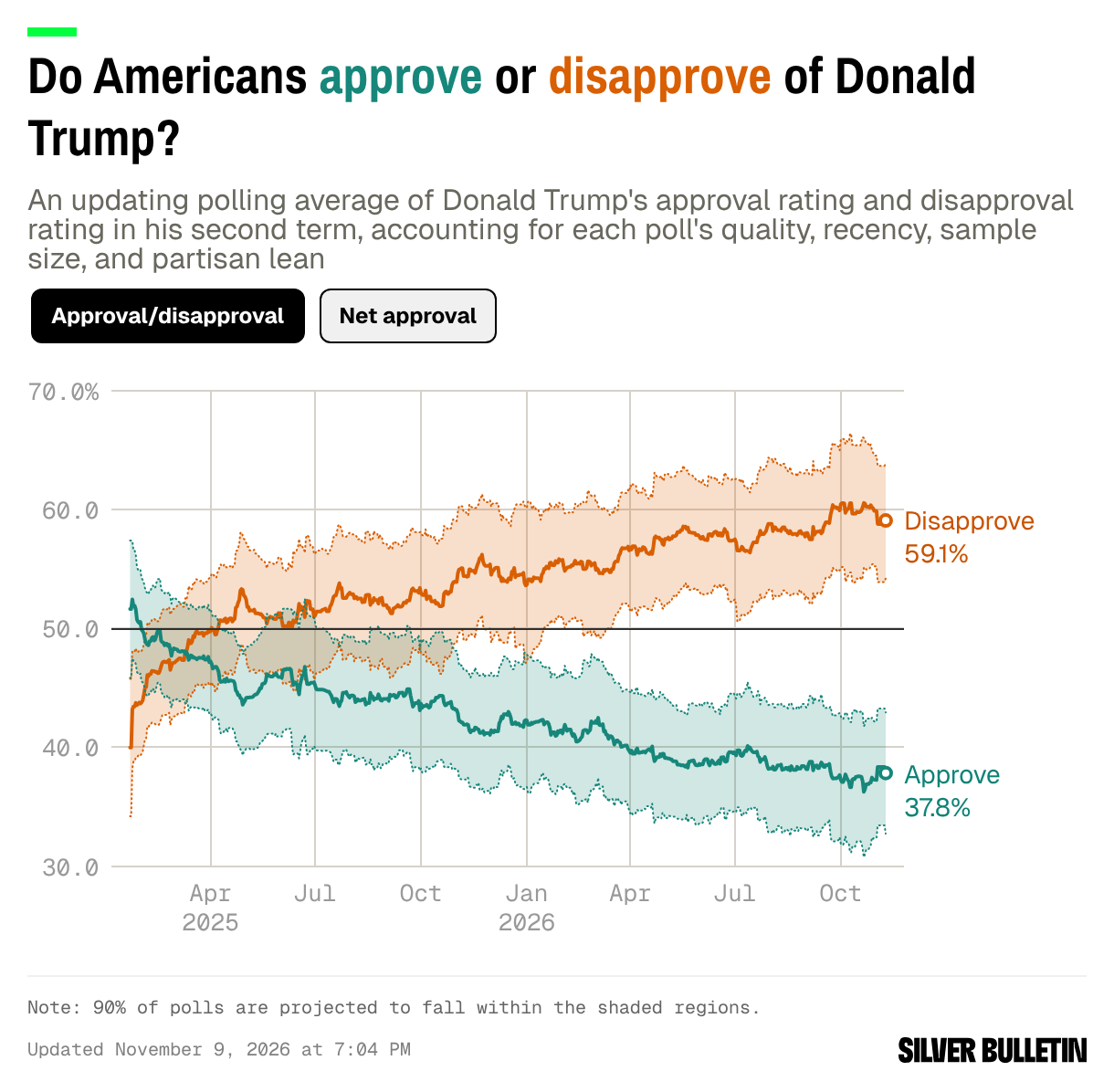
If you look at the chart, you can see that Caldwell’s narrative begins far too late — that the public began souring on Trump far earlier than he lets on, back when he was allegedly faithful to the MAGA agenda. In fact, as the center-right data analyst Sean Trende points out, the first big spike in Trump’s disapproval was in April 2025 — seemingly in direct reaction to the “Liberation Day” tariffs announced on April 2.
Caldwell, to be fair, does acknowledge that the tariffs weren’t exactly well-received. But he insists that this early period was nonetheless one in which Trump’s agenda was still broadly popular.
Yes, Mr. Trump had alienated domestic adversaries and foreign allies alike. He had frightened investors with his manic tariff announcements. But he had come within a hair of winning an outright majority in the popular vote in 2024. Almost a year into his second term, his administration was, if not beloved, at least sustainably popular.
Caldwell insists on this point, incompatibility with the data aside, in order to create a binary between Trump’s first and second years in office — and, by extension, between true and betrayed MAGA. Describing actions ranging from the purge of the federal bureaucracy to the immigration crackdown as basically sensible, he suggests that Trump erred not in policy judgment but in execution.
Trump “could have effectively made the case for raids of the sort he ordered in Minnesota,” he argues, “but “this required explaining, and explaining is something Mr. Trump has always been poor at.” Trump was right to push for greater US control over Greenland, but erred in his “insistence on besmirching Denmark” while doing so.
These arguments are an attempt at ideological hygiene: separating the worldview of the Trump administration (good!) from the way that Trump went about implementing it in 2026 (bad!). But when it comes to Iran, his tone shifts — arguing that the policy itself is not an example of good populism done badly, but a bad idea through and through.
“That war has penetrated every crevice of the Trump administration, discrediting all of it,” he writes. “Districts and states that went for Mr. Trump by large margins in 2024 shifted away from Republicans across the country.”
This is the crux of the Trump dodge maneuver. It is to carve out a separation between “true” right-wing populism — what Matt Walsh calls “America First” — and perceived betrayals of it, which alienated the populist masses.
The overriding focus on Iran reflects the perception that it was a qualitatively different kind of betrayal.
While dodgers may admit Trump’s heavy-handed ICE raids were over-the-top, they insist that essential impulse to crack down on immigration is correct — and thus the failure is one of execution rather than any flaw in the idea of mass deportation. Iran, by contrast, was an in-principle mistake: a knowing abandonment of the alleged “no new wars” component of the America First worldview.
Trumpism cannot exist without Trump
Reading this stuff, the temptation to scream “I told you so” is overwhelming.
Caldwell, for example, moans about Donald Trump’s “vanity, instability and foolishness” destroying his administration. But Donald Trump was quite obviously a vain, unstable, and foolish person, and always had been. The people who centered Trump’s character in their Trump 2 forecasts — primarily resist libs and never Trumpers — are the ones who accurately forecast paramilitary ICE raids and unthinking violence abroad. It was the Trump sympathizers, including Caldwell himself, who suggested things would be otherwise.
It’s not as if these people were blind to Trump’s personality flaws: after this long, no one could be. Rather, it is that they posited that Trump was a tribune of a broader movement — America First, MAGA, Trumpism, whatever you want to call it — whose contours were conjured into existence by the speaker in question.
Iran, sold as the ultimate betrayal, is actually the clearest case in point. While it is now an article of faith among Trump dodgers that the MAGA movement was all about opposing foreign interventionism, no one seems ever to have told Trump that. His critical campaign comments about “forever wars” were belied by a lifetime of hawkish rhetoric and actions.
In his first term, Trump assassinated a top Iranian general, bombed Syrian government targets, and courted war with North Korea. He dramatically escalated US bombings in the war on terror, killing more civilians in Iraq and Syria alone than the Gulf war, Kosovo intervention, and Libya war combined.
Even before all that, Trump’s claim to be a dove was a con. Though he had claimed to oppose US wars in Iraq and Libya, he was (surprise!) lying: he had supported both before they went badly. His record on Iran is particularly hawkish: he first called for a US invasion of Iran over 45 years ago.
To ignore all of that, and posit Trump as the leader of some kind of populist anti-war movement, required a heroic act of ideological invention. From Vance on down, believers in the MAGA movement took Trump’s occasional anti-war rhetoric and ran with it — deciding, against all evidence, that being anti-war was a core principle of a movement led by Donald J. Trump.
This, I think, helps us understand what it is that the Trump dodge proponents are truly trying to dodge.
Partially, it is the familiar avoidance of political movements that crash on contact with reality. Right-wing populism cannot fail, it can only be failed.
But more fundamentally, it is an avoidance of the basic recognition that the movement they invented in their heads was a fiction. Caldwell, Walsh, even Vance: they all claim that there was a standard, out in the world, of what it meant to be America First or MAGA that was independent of Trump’s will. That Trump could be measured against a set of MAGA principles and found wanting.
This is an impossibility. “MAGA” was not an ideology, clearly laid out and agreed upon by its adherents, that united the movement. It was a collection of impulses and right-populist vagaries, united primarily by the man at the movement’s head. It was anti-immigrant, of course, but what that meant in practice shifted with Trump himself.
In March, when MAGA pundits were accusing him of betraying the movement over Iran, he replied that “I am MAGA.”2 And as recently as November 1, Trump’s approval rating among self-described MAGA Republicans was 93 percent — hardly a figure consistent with a movement that believed itself betrayed.
Ironically, it is Trump’s departure that may be most likely to turn MAGA into an actually determinate ideological construct. If he leaves office amidst a ruined agenda, as seems likely, even many currently in that 93 percent will feel like they’re left the bag. They will be hungry to be told that they weren’t conned by an inveterate conman, but rather that the movement they believed in was betrayed and compromised. That True MAGA, whatever that is, has never been tried.
To them, someone like Vance will say he feels their pain, that the elite class is to blame, and that he is their retribution.3
For those of you who were not yet alive or sapient, liberal hawkishness was a big thing in the early 2000s.
In his recent interview with Ross Douthat, Trump did say that MAGA could exist without him. But in context, I take that as referring exclusively to a period after he’s out of office.
Or at least, he’ll try to. It’s very hard to imagine the Vice President in the failed administration pulling off that kind of distancing maneuver.
At first, I read the argument as saying there were coherent ideas behind the Trump movement, and that pundits who blamed the electoral defeat on poor execution were missing the point: the ideas themselves were never going to work. Then I saw that Zach defines the movement as whatever Trump himself supports and believes, rather than as a separate, coherent ideology. That struck me as inconsistent. Was there a coherent ideology behind Trump or not?
Then I understood the point: whatever coherence the movement has comes from Trump's own ideas, not from a separate body of thought called "America First." War is the clearest dividing line. Trump embraces international military action, while America First ideology rejects it. So the ideas behind the Trump movement are simply Trump's ideas. There is no America First movement, only the Trump movement.
Which clearly defines the problem of the right today. How to structure the future of a movement that is defined by one man, independently of that man.
Trump did NOT enjoy an initial period of popularity. You've cut the graph off at about March but if you look, for instance, at Fifty Plus One's poll average, Trump starts off at 38.7% disapproval on January 21, 2025 and clearly starts a steep monotonic increase in disapproval right from the very beginning! By February 27 he is under water. Likewise, Caldwell says "think back to 12 months ago" when Trump was supposedly near 50% but 12 months ago Trump's approval was 41.3% and still relentlessly falling. It's as clear as day so I don't know how Caldwell or Trende (or for another example David Shor) could possibly have missed it -- unless they are selling a narrative.