



One of the few things most people can agree on is that the United States has entered an era of moral collapse. That Americans used to be good, virtuous people who elected good, virtuous leaders — but something’s changed, and now everything is falling apart as a result.
In a Gallup survey from earlier this year, 80 percent of Americans agreed that “the state of moral values in this country is getting worse.” This number has been pretty consistent over Gallup’s 24 years of data; at its lowest point, more than two-thirds of Americans still agreed that our morals are getting worse.
People on the right and the left tend to have very different explanations of what’s gone wrong: the right tends to point to the decline of religion, while the left blames the rise of neoliberalism and/or Trump. But both tend to agree that something has made Americans meaner and smaller people.
I think they’re both wrong. When you look at the actual data on American attitudes and behaviors, there’s surprisingly little evidence that we’re worse than our predecessors. If anything, the story looks more like moral progress than decline.
This really matters. If there had been a collective collapse in our collective decency, it would have pretty devastating implications for our long-term ability to sustain a system that depends on the people ruling themselves. But if people are basically the same, or perhaps even a little bit better, then it would suggest the evident problems in our politics are more structural than personal — the sort of thing that you might be able to fix through legislation rather than a moral crusade to transform the basic belief structures of 340 million people.
I also think believing in moral decline is just bad for you as a person, on a psychological and maybe even a spiritual level.
People warning of moral decline are (almost always) wrong
In a 2023 Nature paper, the psychologists Adam Mastroianni and Daniel T. Gilbert examined an enormous amount of data — 12 million individuals in 60 countries over 70 years — to get a sense of whether they think people are getting less moral. The answers were strikingly consistent: across time and space, most people always think the state of our morality is getting worse.
“Participants in the foregoing studies believed that morality has declined, and they believed this in every decade and in every nation we studied. They believed the decline began somewhere around the time they were born, regardless of when that was, and they believed it continues to this day,” Mastroianni and Gilbert write.
It seems, on its face, very unlikely that people everywhere on the planet have gotten progressively and consistently worse for the last 70 years. But it is possible, so Mastroianni and Gilbert decided to test it — examining a series of questions designed to measure concrete acts of moral and immoral behavior, like whether someone has let a stranger go ahead of them in line in the past 12 months.
Tellingly, the answers to those questions didn’t change much as time went on. So while everyone claimed that things were getting worse, neither they nor others appear to be behaving any worse than the people in older generations.
From this, Mastroianni and Gilbert conclude that moral decline is basically a mental illusion. Other studies show that the media reports more bad news than good, and that humans are more likely to remember bad experiences than good ones. Put those two things together, and you have a recipe for our brains convincing us that mostly bad things happen — making us feel as if the world is going to hell when in fact it’s not.
Yet there are clearly eras in history when moral decline actually happened.
In the early days of North American colonization, chattel slavery didn’t exist. After its introduction, settlers engaged in a lot more casual brutality and got a lot more racist. When abolitionists argued that slavery had made America a crueler and more evil place, they weren’t suffering from delusions; they were reporting an objective fact.
For this reason, I don’t think the Mastroianni and Gilbert method of asking people about their perceptions and behavior is good enough to prove that moral decline isn’t happening today — and they themselves admit as much.1 You’d need to look at more objective measures of moral and immoral behavior in any given society, which we’ll do for the United States shortly.
But I wanted to start with this paper because it provides a really important guide to assessing the evidence.
Mastroianni and Gilbert show, pretty persuasively, that people are strongly biased towards thinking moral decline is real even when it likely isn’t. That suggests that the burden of proof should be on the declinist: they need to show that they’re not deluded, that we’re actually in a 17th century colonial America-style exception to the general rule of moral stability. If the evidence is mixed or unclear, we should see society as innocent until proven guilty.
The left and right are both wrong about moral decline in America
The most popular right and left theories of moral decline in America today focus on each movement’s bugbears: religion and neoliberalism.
The conservative narrative starts from the philosophical premise that morality can only be grounded in faith.2 But the Enlightenment shattered the intellectual foundations of traditional faith, precipitating the recent collapse in Christianity across the Western world. So many of our problems, from rising personal immorality to a crisis of confidence in our political systems, basically stems from a crisis in faith.
“The positive values inherited from the Enlightenment—equality, individualism, compassion—were always parasitic on Christianity. But Christianity, like all religions, has no place in a universe ruled by reason and science” the heterodox scholar Martin Gurri recently argued. “Oblivious to the implications of this calamity, liberal democracy kept marching like a cartoon character over the edge of the abyss, until the laws of moral gravity asserted themselves. So began the Great Fall.”
The left-wing narrative, by contrast, points to the late 20th century rise of “neoliberalism” as the source of our problems. The Reagan-Thatcher ideology, in this telling, was not just about deregulation and lower marginal tax rates. Rather, it was a thoroughgoing remaking of the American soul, a replacement of older bonds of solidarity and social connection with the grim logics of self-interest. Under neoliberalism, everyone has become a little corporation — suborning moral concerns to market logic even in private life.
“Neo-liberalism voids the substance of and undercuts the need for extra-market morality,” the political theorist Wendy Brown wrote in a widely cited 2003 paper. “Consider the way in which consequential moral lapses (of a sexual or criminal nature) by politicians, business executives, or church and university administrators are so often apologized for as ‘mistakes in judgement,’ implying that it was the calculation that was wrong, not the act, actor, or rationale.”
To test these theories, I decided to look at objective indices: data assessing the prevalence of behavior widely seen as either immoral or moral.
Defining “widely seen” was the trickiest part. There’s obviously no consensus on many moral issues, and I want this to be persuasive to reasonable people of all ideological backgrounds. So that means excluding some things that I strongly believe to be evidence of moral progress, like rising support for same-sex marriage. Instead, I looked only at measurable behaviors and attitudes that would be non-controversially good or bad among reasonable Americans.
After thinking through what might count, and looking at what’s actually been studied empirically, I settled on four categories to assess moral decline: 1) the rate of violent crime, 2) the prevalence of explicit racial bigotry,3 3) the degree to which people treat others with kindness and honesty, and 4) how much people give back through charity. This is not an exhaustive list, obviously, but I think a pretty broad spectrum of moral views would agree that all of these are picking up on at least some aspects of good and bad behavior.
Helpfully, it’s possible to assess the right and left declinist narratives with basically the same data. The reason is that the two narratives align temporally: neoliberalism became a dominant force in American politics just a few years before church attendance rates entered free fall. If either story is right, then we’d start to see clear evidence of moral decline in the 1980s and 1990s that continues forward to this day.
The best available data does not support such claims. If anything, it suggests moral improvement.
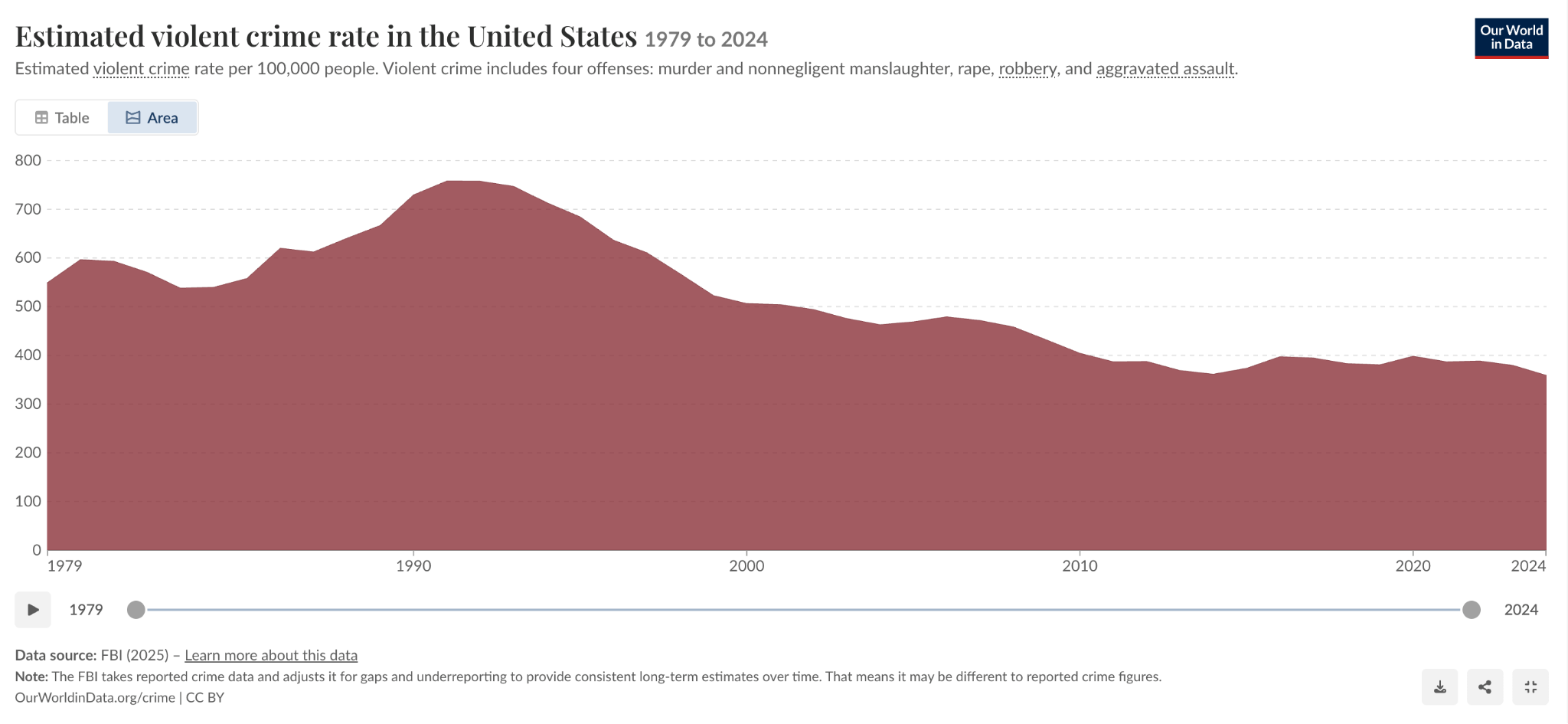
Start with violent crime. An index from Our World in Data — which combines rates of murder, non-negligent manslaughter, rape, robbery, and aggravated assault into a single aggregate number — peaks in 1991. Since then, as church attendance collapsed and neoliberalism (per the left) remained hegemonic, the incidence of these most serious crimes collapsed by more than half. Subsequent rises and falls (such as the murder spike in 2020) do not fit any narrative of broad-based moral collapse.
The data on explicit racial bigotry shows a similar decline.
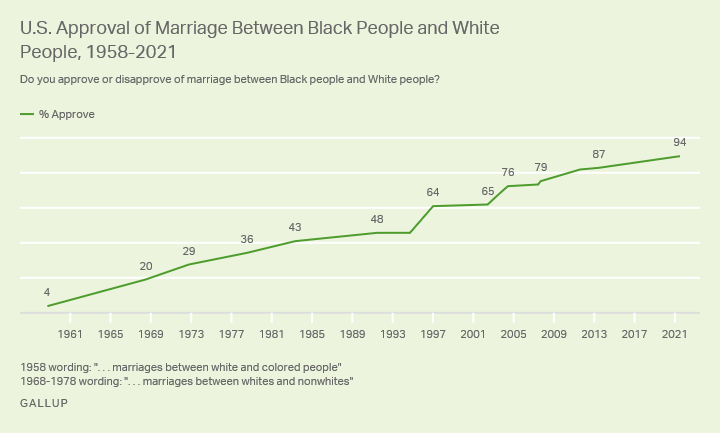
In his 2001 survey of the data on anti-black racism, Harvard professor Lawrence Bobo found that “the single clearest trend shown in studies of racial attitudes has involved a steady and sweeping movement toward general endorsement of the principles of racial equality and integration.”
Updated data tells a similar story. Gallup, for example, found that just 43 percent of Americans approved of interracial marriage in 1983; by 2021, that figure was 94 percent.
It’s a bit trickier to measure whether people have become meaner and more dishonest, but the studies attempting to do so don’t show a consistent collapse in the past 40-odd years.
A recent meta-analysis on social cooperation examined 511 laboratory experiments between 1956 and 2017. In these studies, a group of Americans — usually college students — were asked to play games designed to test whether they were willing to work together to advance collective goals or pursue more narrow self-interest (think prisoner’s dilemma). The study found, contrary to expectations, that people actually became more likely to work together as the years went on.
Noting that these lab studies tend to predict real-world behavior, the authors take this as evidence of a kind of moral improvement.
“We posit that societal trends toward increasing urbanization and people living alone may have shaped a social ecology in which people are more likely to interact with, depend on, and form relationships with strangers,” they write. “These changes in American society may underlie a transition to higher levels of individualism as well as a greater willingness to cooperate with strangers, even at the risk of being exploited.”
Another attempt to measure collective kindness — the prevalence of narcissism among Americans — has long been the subject of a raging statistical debate. Psychologist Jean Twenge, one the leading proponents of the notion that Americans had become more narcissistic since the 1980s, recently published a study showing that there’s actually been a sharp decline since 2008. Other studies suggest the initial spike may never have been real in the first place.
Studies on empathy are mixed: a 2011 study found Americans are becoming less empathetic, but a 2024 paper showed a rebound. And the rate of tax compliance — a decent-but-imperfect proxy for social honesty — has remained high (over 82 percent) and relatively stable throughout the 21st century.
Our final category, giving back through charity, is a more mixed bag.
While there’s been much talk about a decline in charitable volunteering, the actual data shows limited change. A 2020 study found that rates of volunteering increased substantially between 1989 and 2002, subsequently remaining relatively steady until Trump’s election prompted yet another spike (seemingly concentrated among angry liberals).
By contrast, there is pretty clear and unambiguous evidence of a decline in charitable giving. In 2000, roughly two-thirds of American households reported giving to charity; in 2018, fewer than half (49.6 percent) said the same. Whether this is a function of moral decline or rising economic inequality is hard to say, but it’s the strongest point in the declinist narrative’s favor we’ve seen so far.
Yet given the burden of proof, that one data point is clearly not good enough. Looking across our four measures, the overwhelming bulk of the data either points to either no clear change or pretty tangible evidence of moral progress since the 1980s and 1990s — the exact time period where both right and left narratives say things went wrong.
In the absence of better evidence, we should believe that neither the decline of churchgoing nor the rise of neoliberalism has made Americans measurably less moral.
But what about Donald Trump?
One of the most intuitively persuasive rebuttals to the above analysis is just four words long: Donald Trump is president.
Trump is a paragon of vice: a court-confirmed sexual abuser, a fairly open racist, a narcissistic serial liar, and a man so selfish that he actually steals from charities. For such a man to rise to a country’s highest office would seem proof that the aforementioned data is missing something: that there must have been a society-wide moral collapse for such a person to ascend to high office.
This argument, too, comes in right and left flavors. Aaron Renn, one of the most insightful conservatives writing today, links Trump’s rise to a decline in traditional Christian morality.
“Donald Trump is precisely the kind of person whose path to the presidency would have been barred in the previous era in which America was still a Christian-dominated society,” he writes. “Every standard that could have been used to disqualify Trump has been removed or even inverted. Affairs are seen as no big deal. Gambling is now legal and socially approved of; the sports leagues themselves are partners in the business. Relentless self-promotion is what we all do on social media every day. Our culture celebrates crudeness, in both word and deed.”
Renn is right about gambling and self-promotion, but he’s wrong about other specifics. It is simply not true that affairs are now “seen as no big deal;” Americans remain quite judgmental of cheating, with some 90 percent saying it’s morally wrong.
More importantly, there are plenty of remaining moral standards that were invoked to try and deny Trump the presidency. His confession to sexual assault in the Access Hollywood tape and his openly bigoted remarks about Latinos and Muslims were major parts of the case against him in all three of his presidential runs. Trump’s opponents tried to capitalize on moral norms against sexual assault and bigotry, but simply failed to do so.
The left-wing version of the argument starts with that failure: arguing that Trump’s victory despite his very clear violations of widely accepted moral principles is evidence that Americans never really took those principles seriously in the first place. A country that elected a sex pest and a bigot must be a country of sex pests and bigots, or at least people who do not truly object to such behavior.
“We woke up to a president-elect who ran a campaign that was openly misogynistic and racist, who threatened to use the military against his domestic political enemies, and who terrorized our transgender and immigrant communities — because it was the will of the American people.
Because this is who we are,” Will Bunch wrote in the Philadelphia Inquirer in 2024.
I think this argument confuses political and moral dysfunction.
In 2008 and 2012, Barack Obama won the presidency by pretty wide margins. In 2020, voters rejected Trump, as they rejected his party in 2018, 2022, and 2026. Did those elections show that moral standards had returned and receded? That “who we are” changes every two-to-four years?
That’s impossible, especially given the underlying stability in data on moral behavior and attitudes. That suggests that the rise of Trump isn’t best characterized as a kind of collective verdict on America’s moral standards or character, but rather a product of political dynamics that are to some degree severable from morality per se.
Trump got away with being a flagrantly immoral person for three big reasons. The first is that a major chunk of the GOP base actively liked his flouting of shared moral norms, particularly when it came to issues of race and gender. The second is that extreme partisan polarization made non-bigoted Republicans care more about their side winning than enforcing non-partisan moral standards. And the third is that swing voters nowadays are generally frustrated with the status quo in American politics and have developed a tendency to vote for whoever is out of power, particularly when inflation is high.
Of these, the first can be fairly described as a moral deficiency — but I don’t think it’s a new one. There have been bigoted voters in the United States since literally forever; politicians were just afraid to cater to them after the seemingly permanent victories of the Civil Rights movements. Trump merely proved that these voters still existed.4
The second and third conditions, however, are more political pathologies than moral ones — products of structural forces that cannot fairly be reduced to a simple decline in collective moral standards. Partisan polarization does not necessarily make people less moral in the terms we’ve been examining; it just puts them in circumstances where they prioritize one set of moral issues (e.g., abortion) over others (assessments of candidates’ personal character). Swing voters are not generally bad people, but rather (in general) less politically sophisticated and informed than partisans of either side.
The distinction is important: if the problem is not in people’s hearts, but in the political circumstances they find themselves in, then the problem becomes a lot more tractable. What looks like an unalterable spiritual decay brought on by some aspect of modernity might actually be fixable by a majority vote in Congress.
Time to stop dooming
Getting the question of moral decline right is not just a matter of forming more accurate beliefs about the world. It can help us get a better picture of how to fix our society — and even, I think, make us feel better in our everyday lives.
Spend even a second on social media, and you’ll see people of all ideological stripes complaining about living in a hellworld, or late capitalist nightmare, or some other political term of abuse. The basic function of these complaints is to generate an ambient sense of social doom, which — to be fair — is grounded in real concerns. Democratic backsliding in established democracies, for example, was largely unheard of 25 years ago. Climate change has not been averted. Serious people are talking about AI killing or enslaving everyone on the planet.
But when we moralize political concerns, turning them into a collective verdict on who Americans really are, we both foreclose the possibility that things can be repaired and run the risk of being humiliatingly wrong about the country.
Immediately after the 2024 election, the liberal legal commentator Elie Mystal penned a jeremiad in The Nation arguing that Trump has proven America to be a modern Sodom.
“We, as a country, absolutely deserve what’s about to happen to us. We, as a nation, have proven ourselves to be a fetid, violent people, and we deserve a leader who embodies the worst of us,” he wrote.
From the standpoint of 2026, this sounds preposterous. The midterm elections offered one of the most stunning rebukes to a sitting president in recent history. It is implausible, to put it mildly, that the entire national character has been transformed in just two years. Indeed, Mystal himself argued that Democrats won in 2026 by appealing to the electorate’s moral convictions.
“I’d say the things that bind the current party together are not policies so much as principles. Decency, accountability, fairness, dignity…having strong principles helped Democrats everywhere. Authentically standing up for those principles helped Democrats everywhere,” he wrote.
Americans cannot be both “a fetid, violent people” and a polity swayed by appeals to “decency, accountability, fairness, [and] dignity.” The contradiction exposes a problem with moral decline thinking in general: it traps one into either rank inconsistency or collapse into political misanthropy.
Once you come to believe that people as people are getting worse, you start saying things like America “deserves” the last two years of authoritarianism. When things get better in some way, you either forget what you once thought or else assume that something bad will happen soon — because that’s just who we are.
Moral declining thinking thus forecloses our ability to imagine a better politics, a more liberal politics, because it declares that Americans are degraded beings incapable of building something better.
That’s neither a good belief nor a true one. Resist it.
They write: “The subjective measures we analysed are not definitive, of course, but they strongly suggest that the widespread perception of moral decline is an illusion.”
This is a very dubious premise, and has been since Plato’s Euthyphro.
I said I only wanted this to be persuasive to “reasonable” people, and explicit racists are (on the Rawlsian definition) fundamentally unreasonable.
I expect Bunch and most liberals would likely agree with this analysis.
The word “morality” in this conversation seems to convey three distinct but overlapping concepts, mores, morality and ethics. ( I get that the difference between morality and ethics is contentious, but for theis purpose I refer to behavior in society, rules of society, and individual choice of behavior.) Mores, especially in the technological age, change rapidly. Think about the widespread adoption of the smart phone around 2010. This greatly changed behavior in society and introduced many new moral and ethical quandaries. Changing mores effect morality. Morality changes too, more slowly, but inexorably. In contrast from the time Moses came down form the mountain, to when Jesus bore the cross to today, do unto others as you would have done to you defines ethical behavior. How that works in day to day life is the ob of religious and legal systems of morals.
For example, as a teenager in Louisiana I had to wear a blazer, tie, pressed shirt and dress pants and hard bottomed, leather shoes to church. Wearing your Sunday best was considered good moral behavior a show of respect for God and church. This moral belief holds far less sway toady. In fact a big reason for the popularity of mega churches is their come as you are, as you were, as a friend attitude. The moral codes changed. Now if you grow up with a certain moral code representing “good” then changes in that moral code might read “bad” as decline. The underlying ethical behavior may be the same or have improved. Think of the Victorians with their elaborate systems of morality underwriting by child labor in the home country and savage oppression of foreigners. So social traditionalists and egalitarians are both somewhat correct. Morality in the country has changed away from the moral codes they believed fostered ethical behavior. Statistical explanations of actual ethical behavior may differ from beliefs.
But moral change is not relative. Another example involves Congress. Newt Gingrich and Frank Luntz developed a well thought out political vocabulary, a sort of catechism, and instructed Republicans running for Congress to use this vocabulary for the express purpose of demonizing Democrats. This project served the neoliberal ideological purpose of permanently lower taxes. Grover Norquist acted as enforcer of only ever lowering and never raising taxes as a marker of “real” Republicans. Deviation resulted in being outcast as a RINO. This normalization of the demonization of an entire party marked a radical change in the moral codes of Congress, a place where, a few canings aside, had for two hundred years been ruled by the concept of mutual respect, decorum and free debate. This change does represent a decline in the mores, customs and morals of the institution. By neoliberal i mean the use of price as the primary unit of value in economics instead of human labor as the primary value in classical economics. Just as the spokespeople for neoliberalism, Thatcher and Reagan, live downstream from Jevons, Menger and Walras, McConnellism in the Senate and Trumpism in the White House flow downstream from Gingrich’s rejection of the equal rights and respect of his political opponents.
I agree that in many ways acceptance and respect for other people has greatly improved in recent decades with some glaring exceptions. Getting groups of people to agree on the right path to good behavior remains hard as it always has. The U.S. constitutional system is one of the most successful of those attempts, and despite a recent shift in political fortunes, the decline of that system has yet to be reversed.
Great post and I basically agree with all of it. There is, however, some evidence of moral decline specifically in the domain of prejudice specifically since 2020. It's an uptick in the context of much longer term declines, and the success of morality-prioritizing politicians in 2026 elections is good reason to think the American public is not just descending down a one-way path to ever-bigger bigotry
https://www.pnas.org/doi/pdf/10.1073/pnas.2619420123?download=true